Two weeks from closing the doors.
$1.51M
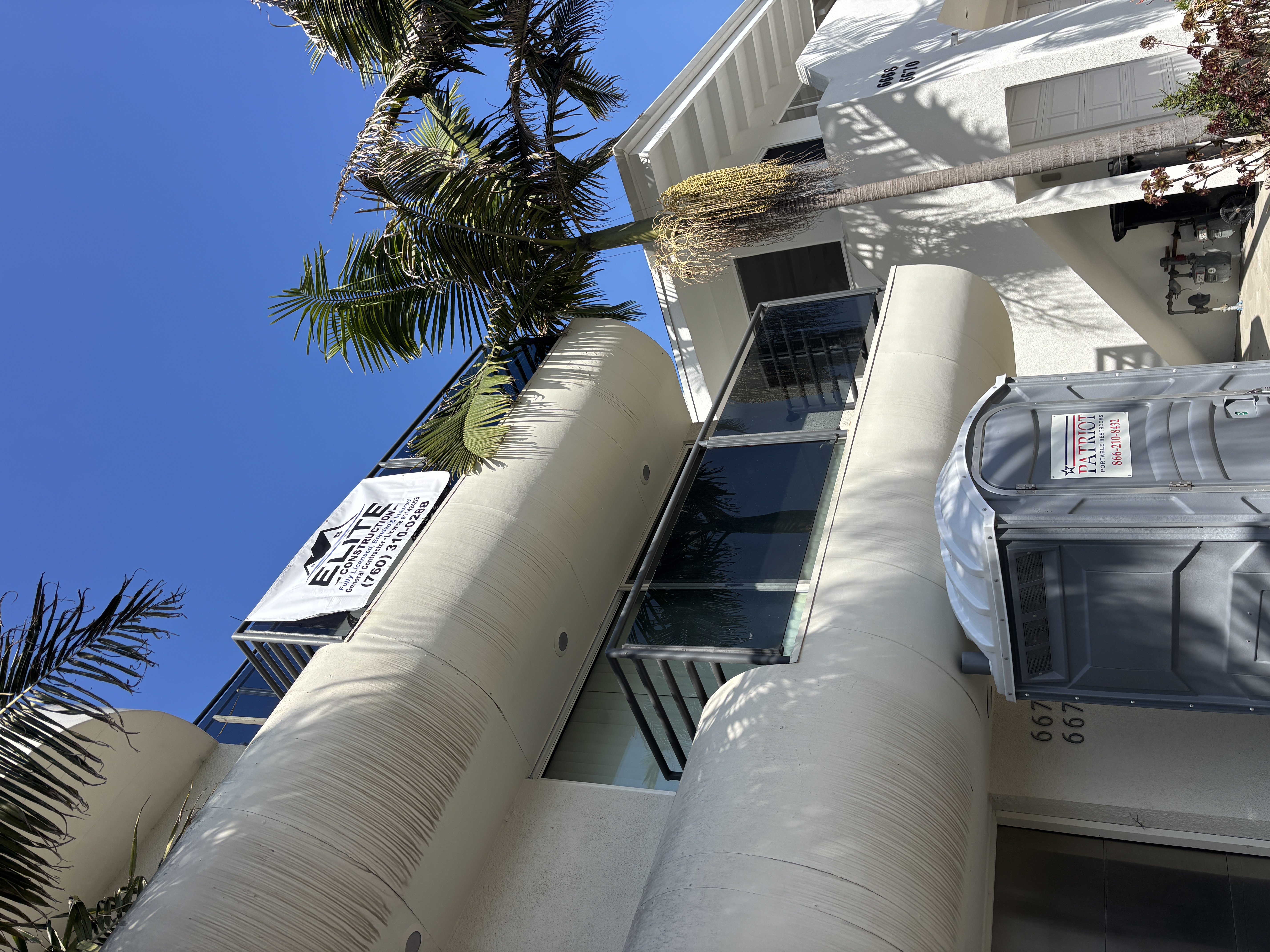
Case · Elite Construction
General contracting · Ventura County
Seven months, Nov 2025 to Jun 2026. $5,910 of Meta ad spend against $1.51M of generated project value.
Growing and scaling the best service businesses.
Everything below this line is evidence. Watch the film first, then apply.
You have the crews, the capacity and the reviews. What you do not have is an acquisition system that follows a dollar from the ad all the way to the deposit. Optic builds that system, operates it, and counts every step of it with you.
Roughly $50,000 to $60,000 of his own money already in, no profit to show for it, and a salaried job offer on the table that would have ended the company. He gave the system seven months instead.
“If you’re a company looking to grow, this is where you come.”
A roofing contractor who brought Optic in to introduce paid acquisition as a new source of demand. The objective was to follow those opportunities far enough downstream to know what revenue they actually produced.
Optic helped build and operate the acquisition infrastructure behind these results. We do not claim sole causation. Figures reflect results reported by each business. Meta creates the demand, the sales process converts the opportunity, and the business itself determines whether the acquisition was worth making. Prior results are not a guarantee of future performance.
“It’s without a doubt a no brainer to use your company.”
“If you’re looking for a partner, and to not burn cash, and you’re looking for results, give these guys a shot.”
Who is worth winning, what they fear, and the words they use when they describe the problem to someone else. Nothing downstream is invented — it is all drawn from here.
The operator who knows their buyer better than anyone else in the market is the one whose name gets said first.
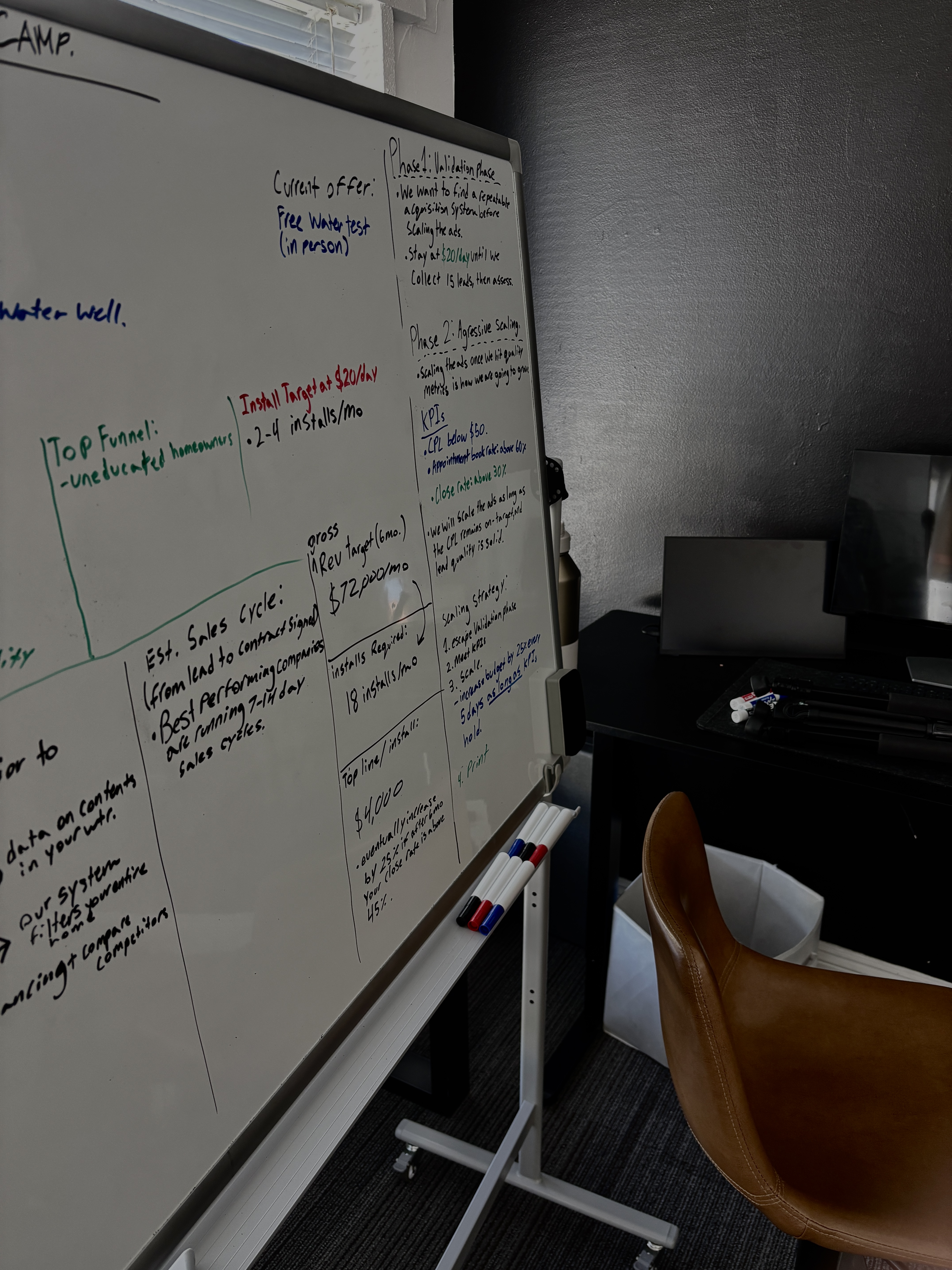
The objective becomes arithmetic: revenue gap, customers required, opportunities required, leads required, investment required. Marketing gets a destination instead of a budget.
A company that can hit a number on purpose is a company somebody eventually wants to buy.
Pathway, CRM, pipeline, routing, qualification, response and attribution, built before a dollar of spend. Paid traffic into a broken path only buys you a faster way to lose money.
Infrastructure is what someone is actually buying when they buy a business. Build it now and you own an asset instead of a job.
Intelligence becomes hypothesis, angle, hook, script, shoot and test, filmed on site and in person. Every asset traces back to a specific thing we learned about your buyer.
Your face and your work, in front of your market, week after week. This is how a contractor stops being a quote and starts being a name.
Campaign architecture, deployment, creative testing and optimisation. Measured on economically valuable demand rather than on the cheapest lead available to buy.
Owning the attention in your service area is the first half of owning the area.
Contact, qualification, appointment, show, estimate, customer. We follow the money downstream until every place it stops moving has a name and a number attached to it.
When every stage carries a number, the business stops depending on you being in the room.
We find what is actually preventing more profitable revenue — creative, conversion, sales, capacity, fulfilment, market or economics. Then we expand against that constraint deliberately, rather than raising the budget and hoping.
Compounding is what separates the biggest operator in the county from everyone bidding against them.
Every month has a document behind it that says what was spent, what it produced, what it cost per customer, and what changes next. The anxious version of this business, the one that finds out how the month went at the end of the month, is gone.
Referrals and word of mouth are wonderful and you do not control either one. When you own a channel that produces qualified opportunities on a predictable schedule, growth stops being a function of luck and starts being a function of decision.
You are the best salesperson in your business, which is exactly the problem. The system runs on documents, pipelines and process rather than on your memory and your phone, so the business can grow past the number of hours you are willing to give it.
Confidence is not a mood. It is knowing that thirty thousand dollars of acquisition investment produces a range of outcomes you can name in advance. That is the difference between spending on marketing and investing in it.
Every stage leaves a document behind and you keep all of them. The buyer brief, the revenue model, the attribution map, the scaling plan. If we ever stop working together, the machine stays with you, because it was always yours.


Spend, leads, qualified, appointments, customers, revenue. Cost per lead is the second number on that list. Most reports stop at the second line, because the four numbers after it live in your CRM and your closed jobs rather than in an ad account. Those four are the ones that decide whether the first one was ever worth paying.
I watched a general contractor come within two weeks of closing his doors while his ad account showed perfectly acceptable numbers. Nothing in that account was lying to him. It simply was not measuring the thing that decided whether he still had a company.
So Optic counts further. We follow a dollar from the ad to the estimate to the deposit, and when it stops moving we tell you exactly where and why. That is slower to sell than a cheap lead promise. It is also the only version of this work I am willing to do.
I am not trying to run this for fifty companies. Local service businesses are one of the last places left where one person's decision still changes the entire outcome. When this works, somebody keeps their crew, keeps their house, and stops lying awake about February. That is worth doing properly rather than quickly.
If you want someone to run ads, there are a thousand people who will take that job and most of them are cheaper than me. If you want the system that turns what those ads produce into revenue you can count, apply, and we will find out on the call whether I am the right person to build it with you.
None of this arrives as a crisis. It arrives as a slow drift. Another year of activity you cannot audit. Attention costs rise every quarter you wait, and more of your competitors learn to buy it properly. The company stays welded to you, so you cannot step back and you cannot sell. And you stay one slow quarter away from a decision you never wanted to make.
Answer honestly rather than impressively. The numbers you put here are the numbers we work from on the call, so approximations are fine and inflation is not useful to either of us.
We are reviewing your application and will get back to you within the business hour.
Nine questions, about four minutes. There is no funnel behind this, no automated sequence, and nothing gets sold to you between now and the conversation.
Every application comes to me. Not an assistant, not a setter, not a call center. I read the whole thing, and I look at what you are already running before I reach out.
A call or a text from me, quickly. A working session on where the business stands and which stage is costing you the most. If Optic is not the right instrument, I tell you on that call.
Nine questions, about four minutes. There is no funnel behind this, no automated sequence, and nothing gets sold to you between now and the conversation.
Every application comes to me. Not an assistant, not a setter, not a call center. I read the whole thing, and I look at what you are already running before I reach out.
A call or a text from me, quickly. A working session on where the business stands and which stage is costing you the most. If Optic is not the right instrument, I tell you on that call.

The version of this business you can already see is on the other side of one conversation.
Start the application